
|
Getting your Trinity Audio player ready...
|
Ohm’s Law 101: The Simple Guide to Voltage, Current, and Resistance
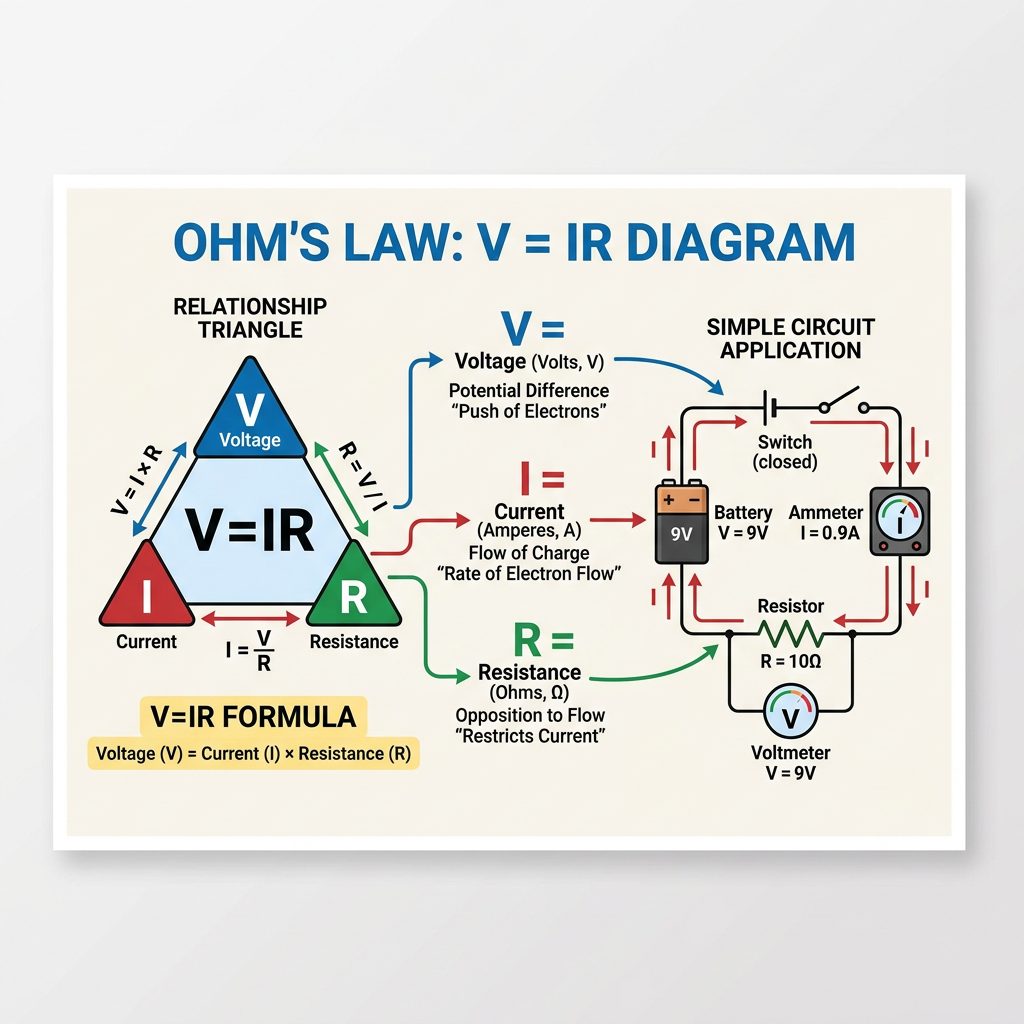
Ohm’s Law is a fundamental principle in electrical engineering and physics that describes the mathematical relationship between Voltage (V), Current (I), and Resistance (R). Formulated by Georg Simon Ohm in 1827, it states that the current flowing through a conductor is directly proportional to the voltage applied across it and inversely proportional to the resistance of the conductor.
The core formula
Ohm’s Law relates voltage, current and resistance: V = I × R.
- Voltage: V = I × R, measured in volts (V).
- Current: I = V ÷ R, measured in amperes (A).
- Resistance: R = V ÷ I, measured in ohms (Ω).
Worked example: A 9 V supply across a 1,000 Ω resistor gives I = 9 ÷ 1,000 = 0.009 A, or 9 mA.
Key Components Explained
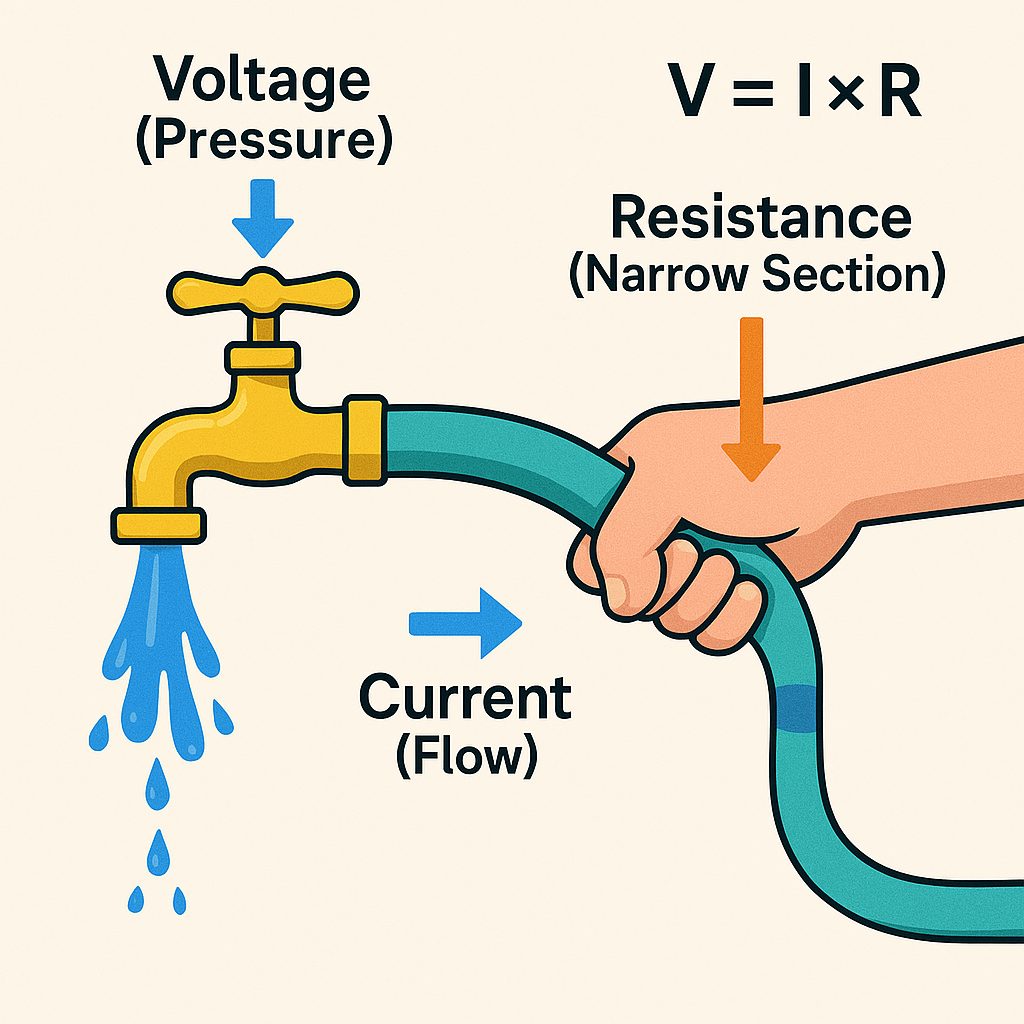
Understanding these three variables is often made easier by using the water hosepipe analogy:
Voltage (V): Think of this as the water pressure. It is the force that pushes the electrical charge through the circuit.
Current (I): Think of this as the water flow rate. It is the actual “stuff” (electrons) moving through the wire.
Resistance (R): Think of this as the pipe’s narrowness. It restricts how much water can flow through at any given pressure.
Practical Applications
Ohm’s Law is a daily tool for hobbyists and engineers for tasks such as:
- Component Selection: Calculating the correct resistor value to protect an LED from burning out.
- Vaping Safety: Vapers use it to ensure their coil resistance is safe for their battery’s output to prevent overheating or venting.
- Troubleshooting: Technicians use it to identify faulty components by measuring unexpected voltage drops or current levels.
- Circuit Design: Designing smart energy systems, optimising charging rates, and managing electrical loads.
Limitations
While foundational, Ohm’s Law does not apply to everything. It primarily works for Ohmic materials (where resistance is constant) and has limits in:
- Non-linear devices: Such as semiconductors (diodes, transistors), where resistance changes with voltage.
- High-frequency circuits: Where complex AC behaviour makes simple DC calculations less accurate.
- Environmental factors: High temperatures can change the resistance of a material, deviating from standard calculations.
What to try next
Apply Ohm’s Law to a simple resistor circuit, then build on it with our Basic DC Circuits lesson. If you are new to physical circuits, start with What is a Breadboard?.